Accredited Member

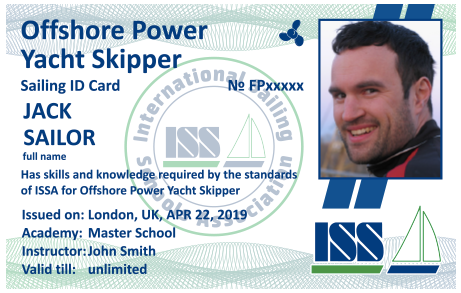
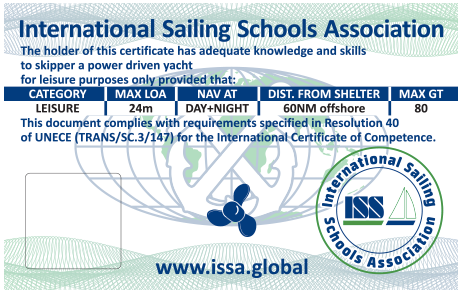
ISSA Offshore Power Yacht Skipper

Course Name: Offshore Power Yacht Skipper
Experience Required: 28 days at sea as skipper / watch leader in at least 2 voyages, at least in 2 sea areas.
Certification Required: Inshore Powerboat Skipper + VHF Radio
Duration: 7 days (5 days theory classes [evening] & 2 days practical training)
Course Competence: To be able to act safely as skipper of a motor yacht up to 24 meters, operating in coastal water (day and night), fair weather, and moderate sea condition.
  • DAY 1 (THEORY)
  • DAY 2 (THEORY)
  • DAY 3 (THEORY)
  • DAY 4 (THEORY)
  • DAY 5 (THEORY)
  • DAY 6 (PRACTICAL)
  • DAY 7 (PRACTICAL)
  • View Certificate
  • Course Calendar

DAY 1 (THEORY) - Time: 17:00 – 22:00

Safety at sea and use of safety equipment aboard
  • Familiarization with electronic navigational aids

  • Types of luxury yacht tenders

  • Types of engines

  • Types of hulls


Compass and magnetism
  • Variation & Deviation

DAY 2 (THEORY) - Time: 17:00 – 22:00

Aids to navigation
  • Channel lateral marks & cardinal marks

  • Safe water mark & special marks

  • Isolated danger mark & Emergency wreck buoy


Marine Navigation
  • Types of charts

  • Common chart projection

  • Nautical publication

  • Chart work instruments

  • Reading chart symbols

DAY 3 (THEORY) - Time: 17:00 – 22:00

Marine Navigation
  • Longitude & Latitude scale familiarization

  • Plotting a position on chart

  • Measuring distances

  • Plotting a course

  • Speed, time, distance calculation

  • Point fix & Running fix


Planning a short passage

DAY 4 (THEORY) - Time: 17:00 – 22:00

International Regulations for Preventing Collision at sea
  • Rules application

  • Definition

  • Responsibility

  • Steering and sailing: Look out, safe speed, risk of collision, etc

  • Lights and shapes

  • Sound and light signals


Tides & Current
  • Tides and its causes

  • Spring tide & Neap tide

  • Tidal definitions

  • How to read tide tables

  • Tidal streams

  • Currents and its causes

DAY 5 (THEORY) - Time: 17:00 – 22:00

Weather study
  • Effect of weather on sailing

  • Sources of weather information

  • High and Low pressure

  • Barometer and Barograph

  • Weather front

  • Warm and Cold front

  • Sea breeze & Land breeze

  • Beaufort scale

  • Types of clouds

  • Types of fogs


Man, overboard procedure & Anchoring technique
  • Possible situations for M.O.B.

  • Types of anchors

  • Considerations before anchoring

  • Preparation for the sea

DAY 6 (PRACTICAL) - Time: 8:00 – 13:00

Vessel preparation for sea
  • Vessel pre-departure safety checks

  • Starting the engines and generator

  • Familiarization with the engines’ throttle and how it works

  • Maneuvering the vessel in a confined space


Carrying out a short passage practically

DAY 7 (PRACTICAL) - Time: 8:00 – 13:00 & 18:00 - 20:00

Vessel handling under power
  • Vessel preparation for sea

  • Maneuvering in confined space

  • Berthing alongside & astern

  • M.O.B. Procedure

  • Anchoring


Night navigation for 2 hrs at the end of the day

Certificate

Course Calendar

2025, NOVEMBER

Course Dates (7 days) Monday 10 to Sunday 16

2025, DECEMBER

Course Dates (7 days) Monday 15 to Sunday 21